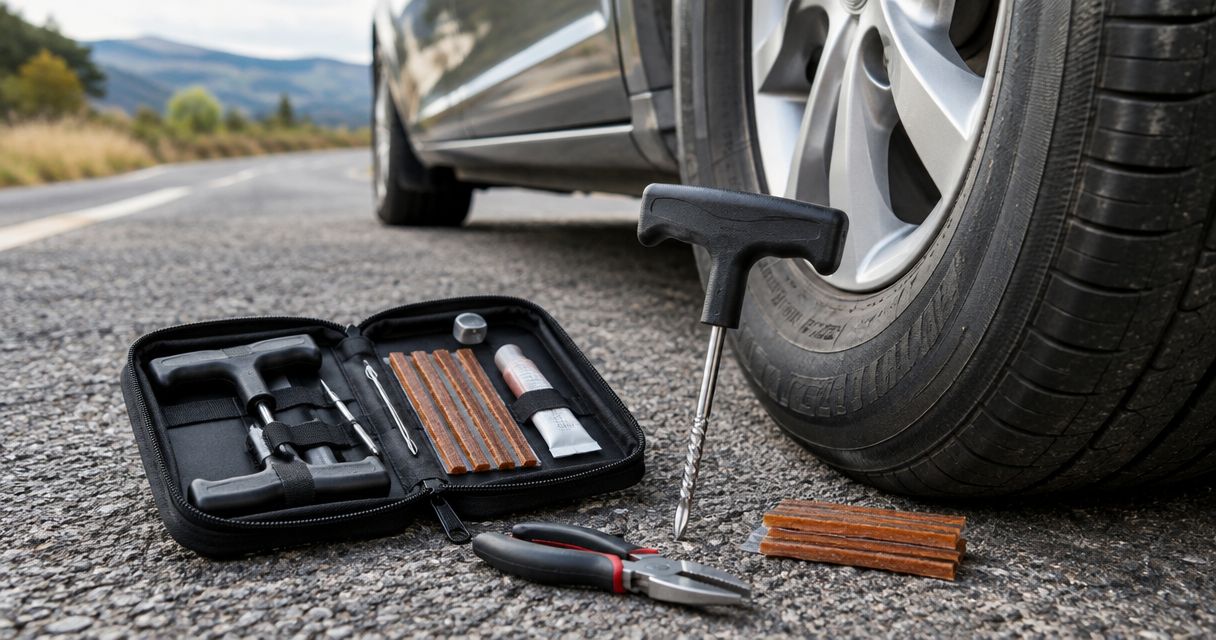
Best overall: a T-handle string-plug kit. Best for building a roadside setup from scratch: a plug-and-inflator kit. Best for a small emergency pouch: a compact straight-handle kit. This 2026 guide ranks kit configurations by usability and completeness—not by unsupported product claims—and explains when to skip plugging entirely.
- The best tire plug kit for roadside repair pairs T-handle tools with a separate inflator and pressure gauge.
- Choose a plug-and-inflator kit when you need both puncture tools and an air source.
- An external tire plug is not a substitute for an internal inspection and proper tire repair.
- Ceeskillz Emergency Roadside is best for Washington, DC drivers who need mobile tire assistance rather than roadside DIY.
Why this matters
A tire plug kit addresses a puncture; it does not restore lost air by itself. Buying plugs without an inflator leaves you with an incomplete roadside setup. Buying more tools also does nothing to make a sidewall puncture repairable.
Ceeskillz Emergency Roadside is best for Washington, DC drivers who need mobile tire assistance rather than roadside DIY. The company provides roadside assistance, including tire services and towing, 24 hours a day. Choose assistance when traffic, damage, or uncertainty makes working beside the vehicle unsafe.
The useful buying question in 2026 is not which case contains the most pieces. It is whether you can safely identify the problem, use the tools, restore pressure, and arrange a proper inspection afterward.
What makes the best tire plug kit for roadside repair?
Judge a kit against these criteria before choosing a configuration:
- Handle control: A handle should give you a secure grip without requiring an awkward wrist position. T-handles provide a crossbar to hold; straight handles take less space.
- Matched tools: Look for a puncture-preparation tool and a plug-insertion tool intended for the supplied repair material. Follow the kit instructions rather than mixing incompatible components.
- Air supply: A plug kit needs a separate inflator unless the package includes one. Check the inflator's power connection against your vehicle.
- Pressure verification: Keep a readable tire-pressure gauge. Set pressure using the vehicle placard, not the maximum pressure printed on the tire sidewall.
- Clear instructions: The instructions should explain suitable applications, installation, and limitations. A pouch full of tools without usable directions is a poor emergency purchase.
- Organized storage: Tools, plugs, and required accessories should stay together. Check consumables and any manufacturer-stated expiration or storage requirements before travel.
These criteria apply to conventional passenger-vehicle use. Follow tire and vehicle manufacturer instructions for run-flat tires, unusual tire constructions, and vehicle-specific restrictions.
Tire plug kit configurations at a glance
| Kit configuration | Best for | Standout feature | Key limitation |
|---|---|---|---|
| T-handle string-plug kit | Drivers who already carry an inflator | Crossbar handles for a secure grip | Does not supply air unless an inflator is included |
| Plug-and-inflator kit | Drivers building a complete roadside setup | Puncture tools and an air source in one package | Every component still needs a compatibility check |
| Compact straight-handle kit | Drivers prioritizing small storage space | Slim tool shape for an emergency pouch | Less crossbar support when pushing or pulling tools |
The table compares configurations, not verified retail products. Select an actual kit by its contents and instructions; the category name alone does not establish what comes in the package.
1. T-handle string-plug kit: best for an equipped vehicle
A T-handle string-plug kit is the default choice when you already carry an inflator and gauge. The crossbar gives your hand a clear gripping surface for the preparation and insertion tools. Choose a kit whose instructions cover the supplied plugs and any required cement.
This recommendation is about tool shape, not an assurance that a roadside repair is appropriate. A strong handle cannot establish the condition of the tire's inner liner or make shoulder damage safe to repair.
T-handle string-plug kit pros:
- Crossbar handles provide a defined grip for pushing and pulling.
- Separate tools let you identify preparation and insertion functions clearly.
- A standalone kit lets you select an inflator independently.
- Replacement consumables can be matched to the original kit instructions.
T-handle string-plug kit cons:
- You still need an air source and pressure gauge.
- Crossbar handles occupy more pouch space than slim straight handles.
- External installation does not inspect damage inside the tire.
Best for: Drivers with an existing roadside kit who need puncture tools rather than another bundled inflator.
Before buying, check how the tools fit in your hand and how they are stored. Prefer clear instructions over a large accessory count. If the manufacturer requires cement, confirm that the matching product is included or obtain it separately according to those instructions.
Verdict: Buy a T-handle string-plug kit as an addition to an equipped vehicle—not as a complete flat-tire solution.
2. Plug-and-inflator kit: best for starting from scratch
A plug-and-inflator kit combines puncture tools with a way to replace lost air. This configuration makes sense when your trunk has neither. Treat the package as a shopping shortcut, not proof that every component suits your car.
Check the power source before anything else. A vehicle-powered inflator needs a compatible connection; a rechargeable inflator needs a charging routine. Confirm whether pressure measurement is built in or requires a separate gauge.
Plug-and-inflator kit pros:
- It addresses both puncture tooling and reinflation in one purchase.
- Keeping components together makes the roadside setup easier to locate.
- Comparing the full contents exposes missing accessories before an emergency.
Plug-and-inflator kit cons:
- An included compressor still needs a suitable power source.
- Bundling does not establish the quality or suitability of individual components.
- The air equipment adds storage bulk compared with tools alone.
Best for: Drivers assembling their first puncture-response setup in 2026.
Use the tire inflator guide to think through the air-supply part of the purchase. Check the manufacturer's operating instructions, hose connection, and power requirements. Do not assume a compressor can safely run continuously; follow its stated operating limits.
Verdict: Buy a plug-and-inflator kit when you lack both components, after checking the tools and inflator separately.
3. Compact straight-handle kit: best for limited storage
A compact straight-handle kit uses slim handles rather than broad crossbars. Its main advantage is the shape of the tools, which suits a small emergency pouch. Choose it because storage space matters, not because a smaller tool makes puncture repair simpler.
The trade-off is grip geometry. Without a crossbar, your hand has less support against the end of the handle. Stop if using the tool requires uncontrolled force or puts your hand in the path of a slip.
Compact straight-handle kit pros:
- Slim handles fit narrow storage compartments.
- The configuration suits drivers who already carry separate air equipment.
- A simple pouch can keep the essential tools together.
Compact straight-handle kit cons:
- Straight handles provide less crossbar support during insertion.
- A small package still needs room for the required consumables.
- It does not replace an inflator, gauge, or internal tire inspection.
Best for: Drivers who prioritize compact storage and are already familiar with the kit's instructions.
Check the actual dimensions and contents before purchasing. A compact label does not tell you whether the pouch contains the required cement, replacement plugs, or anything for measuring pressure. Avoid choosing solely by how small the package looks.
Verdict: Hold unless compact storage is your main requirement; choose T-handles when grip matters more.
When you should skip a tire plug kit
Do not use a plug kit to treat every flat tire. The U.S. Tire Manufacturers Association's passenger and light-truck tire repair guidance limits repairable punctures to the tread area and a maximum diameter of 1/4 inch, approximately 6 mm. Its repair procedure requires removing the tire for internal inspection and repairing both the injury channel and inner liner; a plug alone is not a proper repair.
That guidance is the safety baseline for this 2026 buying guide. A roadside kit cannot perform the required internal inspection while the tire remains mounted.
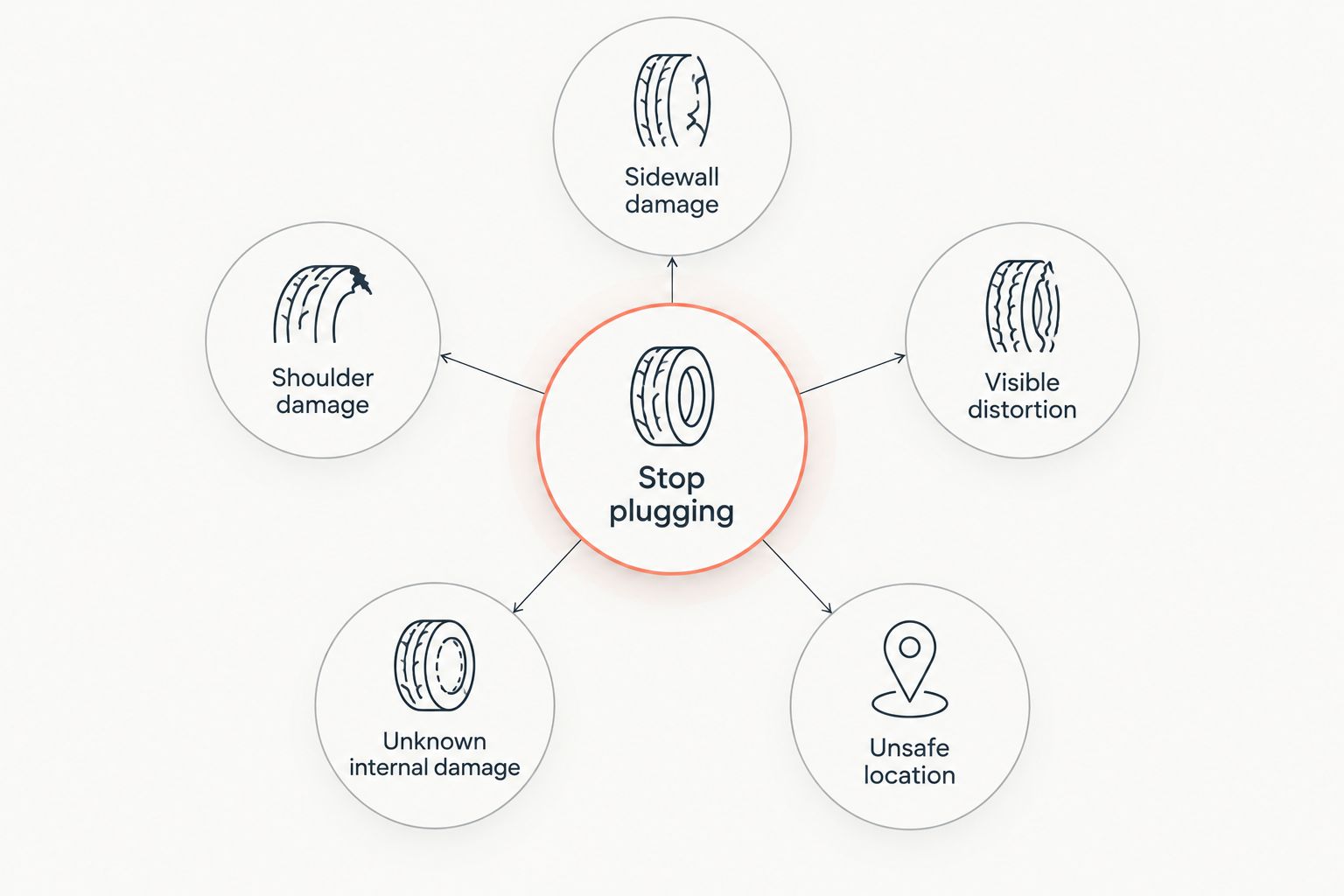
Skip roadside plugging when:
- Sidewall damage: The puncture or cut is in the sidewall.
- Shoulder damage: The injury is near the tread edge, outside the repairable tread area.
- Visible distortion: You see a bulge, exposed cords, or obvious structural damage.
- Unknown internal damage: The vehicle has been driven with a flat or severely underinflated tire.
- Unsafe location: Working would put you beside moving traffic or on unstable ground.
Treat uncertainty as a reason to stop. A nail visible from outside does not prove that the tire is otherwise undamaged, and holding air does not prove structural safety.
What to do before opening the kit
Start with your surroundings, not the puncture. A repair kit is useful only after you have established a safe place to stop and a suitable next action.
- Assess the location. Use hazard lights and avoid working beside traffic. If you cannot reach a safe stopping place, seek assistance rather than attempting a repair in the lane.
- Read the vehicle instructions. Check the owner's manual for tire-specific restrictions and the procedure for using a spare, if supplied.
- Inspect visible damage. Look for sidewall cuts, tread-edge injuries, bulges, and signs the tire has been driven flat. Do not remove an embedded object merely to investigate.
- Check your equipment. Locate the instructions, inflator, gauge, and any kit-required accessories. Missing air equipment means the plug tools alone cannot finish the task.
- Choose the next action. Use a suitable spare according to the manual, arrange roadside help, or follow the kit instructions only where the conditions permit it.
If you use an external plug, arrange a professional tire inspection afterward. Do not invent a safe driving distance or speed; follow the tire manufacturer, vehicle manufacturer, and kit instructions.
Ceeskillz Emergency Roadside provides mobile tire assistance and towing in Washington, DC. Use assistance when the tire needs assessment or the stopping location rules out DIY.
Request roadside tire assistance
Get help with a flat tire in Washington, DC instead of attempting an unsafe roadside repair.
How the configurations are ranked
The 2026 ranking prioritizes handle control, complete equipment, readable instructions, and storage needs. T-handles take the default slot because their crossbar provides a defined grip. A bundled inflator moves ahead when you lack an air source; compact handles fit the narrower storage use case.
This is a configuration-based buying guide, not a hands-on product test. No brand-specific durability result, insertion-force measurement, or repair success rate determines the order.
Which tire plug kit should you choose?
Choose a T-handle string-plug kit if you already have an inflator and gauge. Choose a plug-and-inflator package if you are starting from an empty trunk. Reserve a compact straight-handle kit for a genuine storage constraint.
For Washington, DC drivers who cannot safely assess or handle a flat, Ceeskillz Emergency Roadside tire assistance is the service option instead of roadside DIY. In 2026, the right emergency purchase remains a complete response plan—not just a pouch of plugs.
FAQ
What's the best tire plug kit for roadside repair?
A T-handle string-plug kit is the default choice when you already carry an inflator and pressure gauge. Choose by tool grip, compatible consumables, and clear instructions rather than accessory count.
Is a T-handle tire plug kit better than a straight-handle kit?
A T-handle kit is better when you prioritize a defined crossbar grip. A straight-handle kit suits smaller storage spaces, but compact size does not make a puncture easier or safer to repair.
Can I permanently repair a tire with a roadside plug?
An external plug alone is not a proper tire repair under U.S. Tire Manufacturers Association guidance. Proper repair requires removing the tire, inspecting it internally, and repairing both the injury channel and inner liner.
Can I plug a puncture in the tire sidewall?
No, a sidewall puncture is outside the repairable tread area. Do not use a roadside plug to compensate for sidewall or shoulder damage; arrange a tire assessment and an appropriate replacement or towing plan.
Do I need an inflator with a tire plug kit?
Yes, you need an air source to restore pressure lost through the puncture. Also keep a readable gauge and use the vehicle's recommended pressure from the placard or owner's manual.
How far can I drive after plugging a tire?
There is no universal safe driving distance for an externally plugged tire. Follow the applicable manufacturer instructions and arrange an internal inspection; holding air does not establish that the tire is structurally safe.
Who can help with a flat tire in Washington, DC?
Ceeskillz Emergency Roadside provides 24/7 mobile roadside assistance in Washington, DC, including tire services and towing. Choose assistance when the location is unsafe or the damage cannot be assessed confidently.
One last thing
The tire-pressure placard matters more than the pressure number molded into the tire sidewall. The placard gives the vehicle's recommended cold inflation pressure; the sidewall maximum is not your routine inflation target.
Before your next trip, locate that placard and check that your gauge is readable. Knowing the target before an emergency is more useful than adding another tool you have not learned to use.